Showing posts with label Journalism. Show all posts

Saturday, September 12, 2015

The Bridges of West Kochi

I’d first heard about The Bridges of Madison County from Barry Norman who used to review movies for BBC TV. Those days I’d just begun self-education about Hollywood films so I hardly knew who Clint Eastwood and Meryl Streep were, but, I remembered the title as I felt it was important by the way Barry spoke about it and time and again mentioned the lead players (though I don’t remember what his opinion of this film was). Robert James Waller novel (from which the film is adapted) is one of the first e-books I read after getting a PC at home in early 2000s and saw the movie after learning to use the torrents and downloading films.

The film has stayed with me ever since. But, the real significance of it came to the fore when I got a camera and started thinking of projects to do with the new gadget. That was the time I started thinking about the bridges on this side of the town (obviously not the oft clicked and filmed Thoppumpady bridge). I talked about the project with my dad, auto wallah and cabbie friends, but it didn’t materialise and they all seemed to say unison “these places have filth flowing under them and the stench will be unbearable.”

Yet my dream of being like Robert Kincaid (the nomadic National Geographic photographer played by Eastwood in the film) did not go away. At last I told about the project to my ‘ever ready to help’ friend Raju, he too warned me about the stench factor, still he was game for the adventure. It was decided that we will cover the Kalvathy area in the first leg. “And, no need for an auto, we’ll reach there in 15-20 minutes walking and you can start clicking pictures on the way itself”, Raju’s wise words.

The fun part happened when we thought we’d covered 90% of the distance, we realised that we were heading towards Cherlai Kadavu instead of Kalvathy. “I’ve seen a bridge ahead and thought it was the same,” Raju said.

“I meant the one near the State Bank.”

“I think that is the other end and I don’t think that we can reach there walking.”

This in a way proved to blessing for us as we discovered an unexplored and virgin part of the town and it proved to be exotic in every sense of the term with bridges to be found at every few steps and life lulling around on a lazy Sunday afternoon.


A petty shop as we approach the bridge

From the centre

This is where the friends bond
Those friends put me on the footpath
A mansion across the bridge
They aren't amused
A place to worship across the bridge
Ranjith etta bless me
The sight on my Right side
What would the world be without The Mother?
And, of course Raju - My Friend. A 1000 Danks.

Wannabe Robert Kincaid telling bye until he visits another Bridge.

Saturday, March 21, 2015

A Strange Place Other Than Earlobes

No, no... This isn’t a post about my fetish for earlobes (one of the softest and smoothest part of the body). In fact it is the title of anthology of corporeal poems by five contemporary poets that includes my good friend Binu Karunakaran. The book was formally launched on the 19th of this month at a function in the Kochi-Muziris Biennale 2014.

Here are a few pictures that I could click of the function:

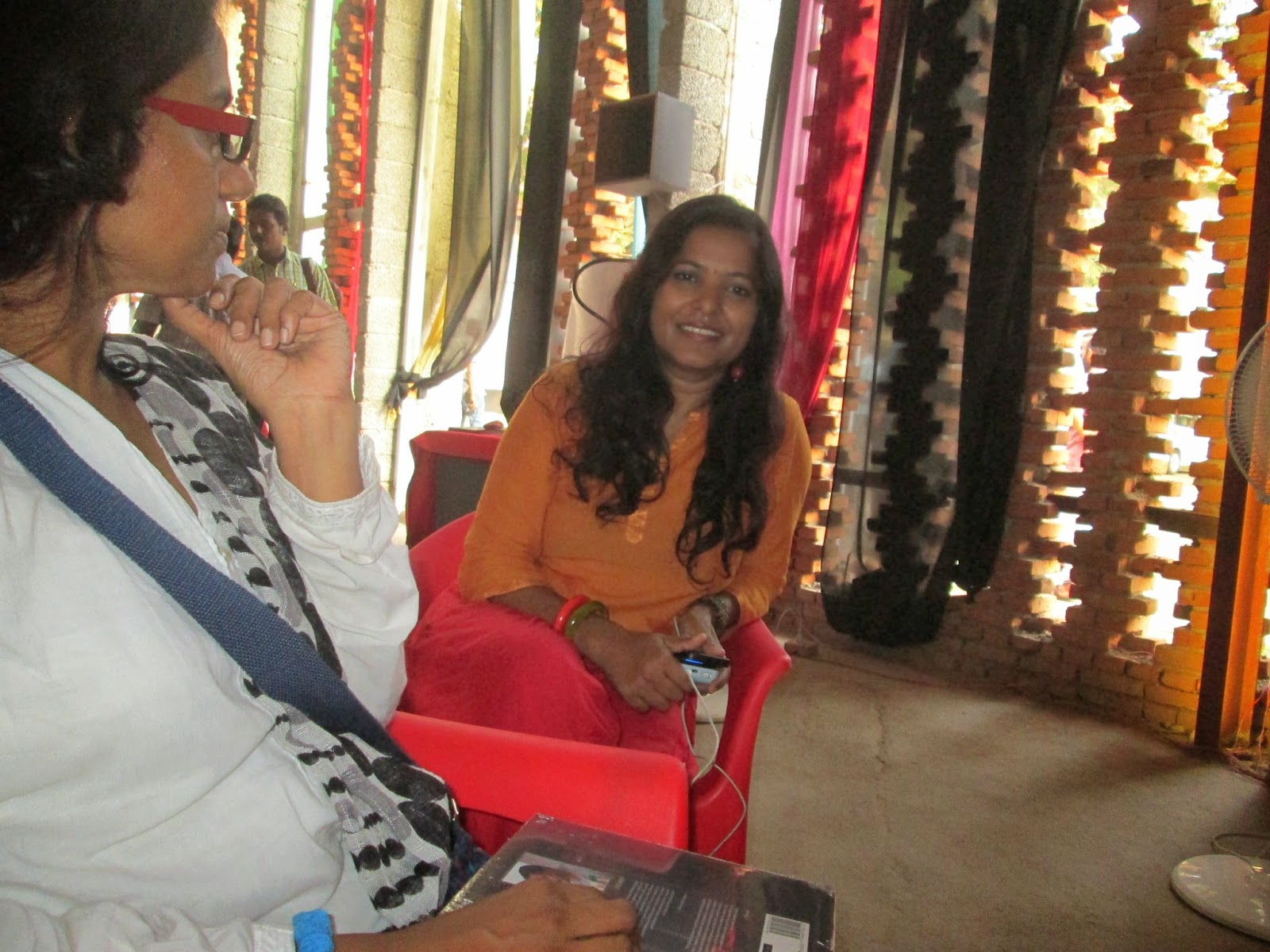
Leena Manimekalai - the Chief Guest, a few moments spent together before the function
Dr. Sreelatha - one of the five poets featured in the book, giving a brief introduction of the book
Riyas Komu - initiating the proceedings
It takes mammoth effort to unravel a book
Ra Sh & Binu seem to be wondering if they will get a chance to speak
Meditating Riyas
Star of the Biennale & a fan
His moment did come
A sign of Arrival - Amol Palekar asking you to sign his copy of your book
You don't get Amol Palekar seated next to you everyday. So, just freeze the moment


Sunday, March 24, 2013

Quality Time Spent with my Screen Pappa (Lal)

I'd gone to meet Lal for a chat after his performance in Ozhimuri got Special Mention from the Jury in the recently announced National Film Awards (2013).


I'll attach the interview here once it is up tomorrow.

Tuesday, November 13, 2012

Education: By Mani Ratnam via Baradwaj Rangan

The religious significance of Vijayadashami is well known, the day is also known as Vidyarambham when young ones are initiated into the world of letters. In my school days Ma used say that you'd learn something today as it is an auspicious day, at least do your homework. I've carried on that ritual to this day – not because I'm overly religious or something. It just makes me feel good to read or write something new. So, this year I picked up Conversations with Mani Ratnam by Baradwaj Rangan. And, one of the most interesting passage I read that day was: 

This shift from paper to film, this metamorphosis, is the chemistry that makes or mars a director. That was the first day, and by the third or fourth day I remember telling Balu Mahendra, 'I want to run.' And he said 'Don't worry, I felt it the first day when I started directing a film.' He said that the disillusionment would pass soon, and he was right – in the sense that you slowly start learning that this transition from paper, from the abstract to reality, is your coming to terms with a different medium, that you have to rediscover everything in this medium. You actually reinvent your ideas on film. There has to be a leap from paper to screen. That's the job of a director – to elevate what's in the script to the next plane. You have to put in an effort to bring in other elements to make it alive. That is the key – to make it alive, to make it magical. You have to take the elements around you and invest them in that scene. You have to be able to draw the actor into that particular moment, so that he will bring something of himself into the character he is playing. It is like shedding one skin and taking on another. The most difficult thing in the first phase was this transition. And then you discover that there are some things that you cannot write and can only capture. Whatever you write, the magic of capturing the moment, a face, an expression, a bit of light, a movement – and you really discover that while making films. You discover that those are the things that really elevate a scene on the page to the next level. 

As I'm grappling with a story idea for a film for the last few months, having virtually no idea about how  to put my vision on to the paper and then transposing it on the screen, I feel that this passage may prove to be the guiding light for me. 

Here is an old post about Baradwaj Rangan's interview with Rajiv Menon. 

PS. I've completed reading almost hundred pages of the book (upto the chapter covering Anjali) till now. 

PPS. Sorry, if this post sounds dated as Vidyarambham has become history now and Diwali is upon us. But it is better late than never, na? 

Happy Diwali!

Wednesday, September 12, 2012

Two Men Two Videos


There are two men I admire the most in films; one is   Clint Eastwood, after watching Million Dollar Baby I started digging his material, mostly the films he has directed rather than acted and I'd say that I haven't felt disappointed once. The other is Anurag Kashyap, we are of same age and I always felt that we shared a brotherhood of struggle (or whatever you may call it), he has surpassed that phase now but I'm still stuck there. And, the other thing we share is our dislike for Sanjay Leela Bhansali's Black.

And, if you're wondering what makes these two eminent men to share space here, it is just that I saw  two videos with these two guys in the last few days:

The first video is of Eastwood's speech at the Republican National Convention in Florida a few days back.


I don't have much knowledge of American Elections, so, can't really gauge the impact of this show but it brought into my mind the Malayalam saying 'however old the squirrel may be it never forgets the skill of climbing trees' (the Hindi equivalent of this borders on being an insult, so not mentioning here), same way Eastwood never stops being macho. Here is Roger Ebert's take on the whole  thing.

The second video is of Anurag speaking about his film Black Friday in Brazil last year.


Here is my short take on Black Friday the book from which the movie is adapted.

PS: As Anurag mentions in the video I too had seen the film on DVD sourced from roadside vendor in New Delhi, when my brother had gone there.
PPS: Special thanks to my Facebook friend Binu Narayan who'd posted Anurag's video there on the tenth (Arurag birthday).

Monday, October 24, 2011

The Ghost Writer

We may never judge a book by its cover because it is nailed into our heads even before we begin to learn the nursery rhymes. But, what happens when you have seen the film based on a book and that too a gripping one? You go to the book expecting to be in line with the film, maybe little clearer and the characters etched with more depth and empathy; that is all. No, not at all! You be ready to be surprised and even shocked as the book takes a totally different trajectory or to another realm.

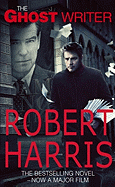
This was the feeling I'd while reading  The Ghost Writer (the American imprint of The Ghost as published in the UK) by Robert Harris, which is adapted into a film by Roman Polanski.

The story is political thriller where a nameless London based ghost writer (the book is narrated in first person by the writer himself without ever letting out his real name), who is called into to finish the work on the memoirs of the former Prime Minister Adam Lang (a character said be based on Tony Blair), when the man working on them is found dead just a month before the deadline for submitting the manuscript to the publishers. So, the Ghost heads to the USA to be with Adam Lang and his team holed up in Martha's Vineyard in Massachusetts, the summer holiday home of the rich publisher Martin S. Rhinehart to finish the book. Obviously, the sailing isn't smooth as the Ghost had expected. First, the manuscript he has been given to work with is bland and needs overhauling. Second, Lang is very reluctant to open up about is youth and his years in Cambridge, and, there is discrepancy in what Lang says about his entry into politics and the actual version as the Writer finds out through his research. There is more to come in terms of thriller and conspiracy theory.

The film starring Pierce Brosnan as Adam Lang and Ewan McGregor in the title role is loyal to the book as far as the thriller part of the story.

But, what I loved about the book is the fact that at least half of it is a writer's manual, a ghost writer's manual to be precise without the dreaded 'Do it yourself' exercise with the process of writing dealt with in detail; from drawing the Contract to how to present yourself in front of your subject. Everyone of the seventeen chapters begins with a quote from Andrew Crofts' seminal book titled Ghostwriting thereby giving direction about how the story will move in the said chapter.

Couple of interesting passages from the book:

All good books are different but all bad books are exactly the same.

Of all human activities, writing is the one for which it is easiest to find excuses not to begin – the desk's too big, the desk's too small, there is too much noise, there is too much quiet, it's too hot, too cold, too early, too late. I had learned over the years to ignore them all, and simply start.

A book unwritten is a delightful universe of infinite possibilities. Set down one word, however, and immediately it becomes earthbound. Set down one sentence and it's halfway to being just like every other bloody book that's ever been written. But the best must never be allowed to drive out the good. In the absence of genius there is always craftmanship. One can at least try to write something which will arrest the reader's attention – which will encourage them, after reading the first paragraph, to take a look at the second, and then the third.
This in no way means that this book is very high funda or technical; it can be enjoyed by anyone who is interested in listening to a good story.

PS. Searching for this book was an experience in itself. It was last year in Bengaluru; I went into an upmarket book-store and asked for this book. At least half a dozen of sale-people converged around me and virtually emptied the whole of the 'Horror' section on my lap. Ma and my sister-in-law had a hard time explaining to them that I wasn't interested in horror stories but just wanted a novel titled The Ghost written by Robert Harris. In the end, they themselves had to dig it out from somewhere for me.

Sunday, October 30, 2005

Interview with Pandit Vishwa Mohan Bhatt

The ‘charmer of the world’, that is what his name means. And, he remains true to his name; he mesmerises and enthrals the listeners with his music. That is Pandit Vishwa Mohan Bhatt for you. The inventor of Mohan Veena (a modified version of Hawaiian guitar made to suit the rigours of Indian Classical music), Vishwa Mohan Bhatt left the city listeners spellbound with his music. The magical spontaneity of his instrumental music interspersed with his singing left the listeners speechless.

The concert was held in aid of Raksha, an institute taking caring of children with special needs. The maestro reached the institute the morning after the concert to inaugurate the newly built hostel facility for the students of Special Teachers’ training course conducted by the institute. Panditji (unperturbed by the raucous excitement all around him) sang for the children and also listened and appreciated the talent of few singers bred by the institute.

The musician and his instrument have become synonymous over the years, but the beginning of his attraction and fascination for the western instrument is not commonly known. Pandit Vishwa Mohan Bhatt started his tutelage under his musician father with a traditional Sitar. Guitar came into his life when a German lady came to his father to learn music from him. The household had every kind of traditional instrument, so they decided to buy the guitar which the German lady was carrying. Being of an impressionable age Vishwa Mohan was fascinated and started playing instrument lap-style. It was similar to a Vichitra Veena or a Ghotu Vadiyam “I was attracted to this instrument and started playing it”, he explains. The modifications came later. “I thought of doing something new, and Mohan Veena took birth”, says the creator with diminutive pride.

Mohan Veena has almost 20 strings in the place of 6 strings found in a normal guitar.

Vishwa Mohan Bhatt has time and again dabbled with fusion music, which has also brought him international recognition in the form of a Grammy Award in 1994 for his album ‘A Meeting by the River’ in collaboration with Ry Cooder. He feels that fusion music is just the utilisation of your music in a different dimension. Some orthodox people are against it because they feel it is a dilution of purity of our traditional music. It is a comparatively new concept and will take some time to be accepted. “I am against the dilution of purity when somebody is practising pure classical music”, he adds.

The subject of fusion music brings into focus the recent trend of ‘Musical Reality Shows’ on television. The maestro feels that the trend should be appreciated for it brings music into focus in true spirit. But on being probed further about the competitive streak propagated by these shows, which is against the tenets of Indian Classical music: he agrees that he dislikes the tendency to pit one singer against another and judges making bad remarks if a singer takes a false note and singer crying in front of all the people. “Music is the individual identity of a singer, just as your face is your identity, so judging who is better among two given singers is not good”, he says and adds that he used to like ‘Sa Re Ga Ma’ (telecast on Zee TV) for it projected the talents of individual singers, but in recent days it has taken the same path as others.

Vishwa Mohan Bhatt has also lent talent to film music also. He has played for A. R. Rehaman in films like ‘Iruvar’, ‘Thiruda Thiruda’, ‘Sathiya’, ‘Lagaan’ and a few
others. His independent composition for Jug Mohan Mundra’s controversial film ‘Bavandar’ got rave reviews in the festival circuit.

Vishwa Mohan Bhatt is positive about the future of his invention. “I have been playing this instrument for the last 38 years and in my own humble way contributed towards music. Now my students from world over (including my son Salil) will carry it forward.


An edited version of this interview appeared in The Hindu